
Tip: Make Feedback Matter More Than Grades
If we want students to use feedback, we have to design assignments that make it matter.

Most instructors spend a significant amount of time writing thoughtful, detailed feedback on student work. Yet many have had the same frustrating experience: students glance at the grade, skip the comments, and move on.
This isn’t a problem of effort or motivation—it’s a problem of design.
When grades and feedback appear together, the grade becomes the dominant signal. It tells students what matters most, often overshadowing the feedback intended to support improvement. As a result, even carefully crafted comments can go unread or unused.
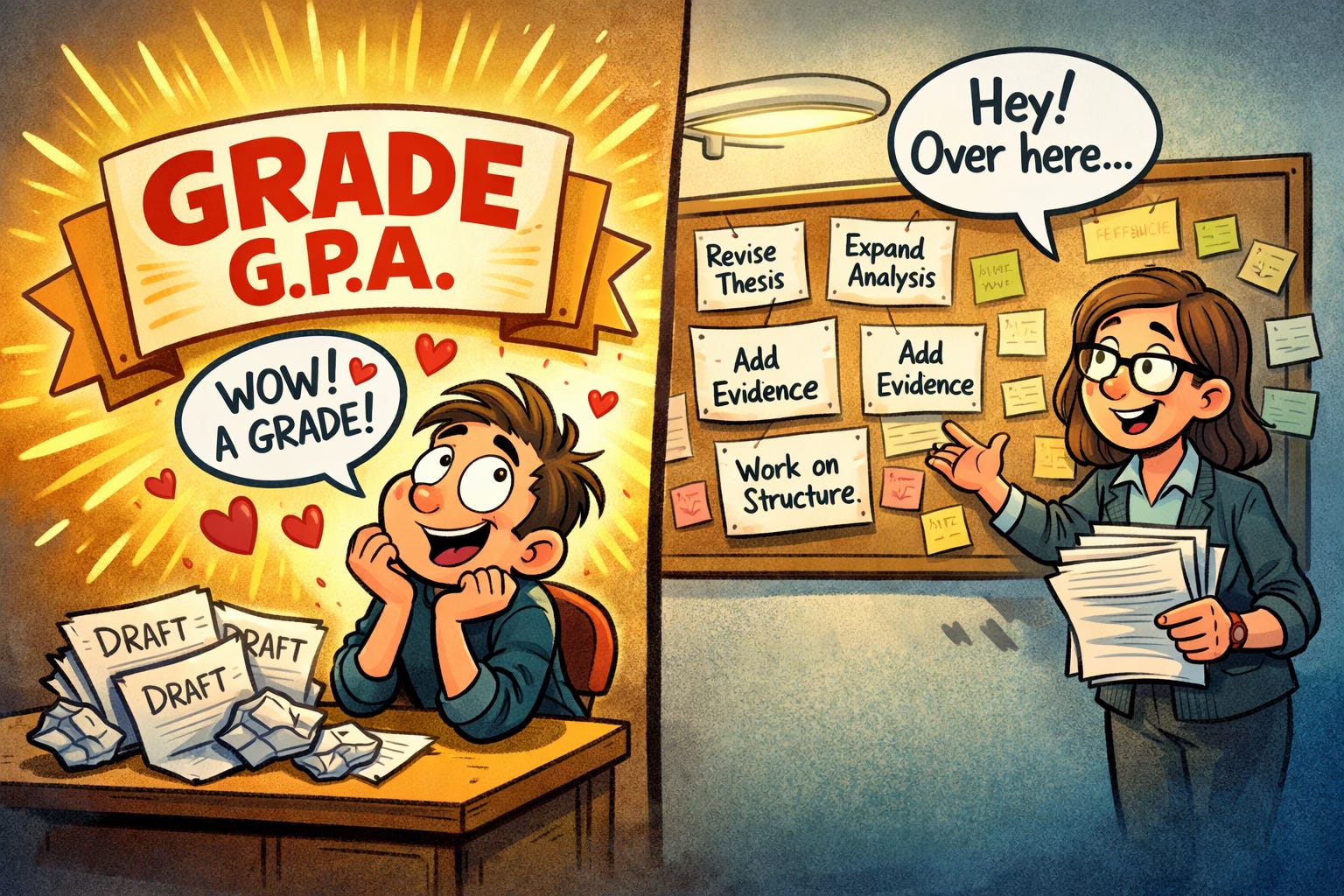
In my work with faculty exploring alternative grading practices, this pattern comes up consistently. Instructors describe investing substantial time in feedback, only to find that students fixate on the score. The issue isn’t the quality of the feedback—it’s the structure surrounding it.
One way to shift this dynamic is to separate evaluation from revision.
Feedback Before Grades
Provide feedback on early drafts without assigning a grade. At this stage, feedback functions as guidance—helping students make decisions, test ideas, and refine their approach before their work is evaluated. When early feedback is ungraded, students are more likely to engage with it as information rather than a verdict. Students need space to interpret and use feedback without the cognitive and emotional weight of evaluation. Removing the grade at this stage reduces defensiveness and redirects attention toward improvement, helping students see feedback as part of an ongoing process rather than a final decision on performance.
What this looks like…In a research-based assignment, students submit a proposal or partial draft several weeks before the final paper is due. Instead of assigning points, the instructor provides focused comments on the project’s direction, such as the clarity of the research question, the strength of the evidence, or the organization of ideas. Students are told explicitly that this draft is a space for experimentation and that the purpose of feedback is to help them make stronger decisions before final submission.
Response Before Revision
Ask students to respond to feedback before submitting revisions. Having students actively respond to feedback through a brief reflection or revision plan turns feedback from something received into something processed. This builds the kind of sensemaking so important to student learning: students articulate what they understand, what they will change, and why. It also creates accountability without relying on grades, reinforcing feedback as dialogic and iterative rather than one-directional.
What this looks like…Students submit a draft and receive targeted feedback focused on key goals of the assignment. Before revising, they complete a short feedback response memo where they (1) summarize the key feedback in their own words, (2) identify 2–3 specific changes they plan to make, and (3) note any feedback they are choosing not to implement, with a rationale. They submit this memo alongside their revision, making their thinking visible and positioning revision as a deliberate, informed process rather than a surface-level edit.
Final Grades Only
Delay grading until the final version of an assignment. Evaluation then reflects what students ultimately learn and produce, rather than how their work looks in progress. Instead of assigning value to each stage, grading is reserved for the culmination of students’ thinking, after they have had opportunities to revise and improve. This supports risk-taking and revision, key elements in alternative grading and process-oriented assessment. It also better aligns grading with demonstrated learning over time, rather than snapshot performance, which is essential for creating more equitable and learning-centered assessment ecosystems.
What this looks like…In a statistics course, students complete a multi-stage data analysis project over several weeks. They submit an initial dataset selection, a draft analysis with visualizations, and a preliminary interpretation, receiving feedback at each stage but no grades. Early submissions may include incomplete or incorrect analyses, which are treated as part of the learning process. Only the final report is graded, based on the accuracy of the analysis, clarity of interpretation, and how effectively students have addressed earlier feedback. This approach allows students to refine their statistical reasoning over time and ensures that evaluation reflects their developed understanding, rather than early missteps.
These practices work best not as isolated strategies, but as a coherent model that lowers the stakes of early work, requires students to actively engage with feedback, and ultimately evaluates learning based on how their thinking develops over time. It’s a simple but meaningful shift in how we design assessment. When feedback becomes the primary signal, rather than something students encounter after judgment has already been rendered, students are more likely to engage with it, make sense of it, and use it to improve their work. Over time, this shift can change not only how students respond to feedback, but how they understand the purpose of assessment itself. If we want feedback to matter, we have to design for it to be used.

More reading…
Bayraktar, Breana, Kiruthika Ragupathi, and Katherine A. Troyer. 2025. “Building Trust Through Feedback: A Conceptual Framework for Educators.” Teaching and Learning Inquiry 13 (January).
Buckley, Alex. 2025. “What’s so New about the ‘New Paradigm’ of Feedback?” Assessment & Evaluation in Higher Education, November 20, 1–15.
Carless, David. 2025. “Feedback Literacy Concepts and Practices: Toward Academic Feedback Literacy.” Change: The Magazine of Higher Learning 57 (5): 5–11.
Coppens, Kurt, Lynn Van Den Broeck, Naomi Winstone, and Greet Langie. 2025. “A Mixed Method Approach to Exploring Feedback Literacy through Student Self-Reflection.” Assessment & Evaluation in Higher Education 50 (2): 173–86.
Hawkins, Brittany, Daniel Taylor-Griffiths, and Jason M. Lodge. 2025. “Summarise, Elaborate, Try Again: Exploring the Effect of Feedback Literacy on AI-Enhanced Essay Writing.” Assessment & Evaluation in Higher Education, April 22, 1–13.
Winstone, Naomi, Karen Gravett, Christy Noble, et al. 2025. “Manifesto for Feedback in the Age of Generative Artificial Intelligence.”